
Fruit Anthocyanins: The Benefits Behind the Color
We have all heard that we should “eat the rainbow,” but there is actually a lot of science behind that recommendation. The beautiful red, blue, purple, and deep burgundy colors found in berries and other fruits come in part from compounds called anthocyanins.
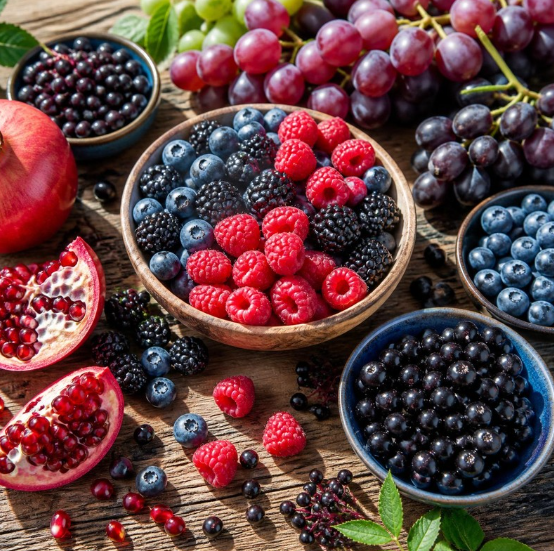
Anthocyanins are a type of flavonoid, or plant nutrient, with antioxidant and anti-inflammatory properties. They are found in foods such as blueberries, raspberries, blackberries, elderberries, aronia berries, pomegranates, and red and purple grapes.
What makes anthocyanins particularly interesting is their ability to support our blood vessels, circulation, metabolic health, and connective tissue.
Supporting Healthy Blood Vessels and Circulation
One of the areas where we have the most research on anthocyanins is cardiovascular health.
Our blood vessels are lined by a thin layer of cells called the endothelium. A healthy endothelium helps our blood vessels relax and contract appropriately, supports healthy circulation, and plays an important role in maintaining cardiovascular health.
Anthocyanins appear to help protect these cells from oxidative stress and inflammation while supporting nitric oxide production and healthy blood flow.
Research has also found that anthocyanins may have a positive effect on cholesterol and triglycerides. Some studies have shown reductions in LDL cholesterol and triglycerides along with improvements in HDL cholesterol.
Over time, these effects may be one reason why diets naturally higher in anthocyanins have been associated with better cardiovascular outcomes.
Anthocyanins, Capillaries, and Collagen
Anthocyanins also have an interesting relationship with our smallest blood vessels, the capillaries.
Capillaries are responsible for delivering oxygen and nutrients into our tissues while also helping move waste products away. Maintaining the integrity of these tiny blood vessels is important for healthy circulation throughout the body.
Anthocyanins have traditionally been used to support capillary strength and decrease capillary fragility. Their antioxidant effects may also help protect collagen and other components of our connective tissue from oxidative damage.
Collagen isn’t just important for our skin. It provides structure to our blood vessels, bones, joints, tendons, ligaments, and many other tissues.
There is research looking at how anthocyanins may influence collagen production and the remodeling of the extracellular matrix surrounding our cells. We are still learning about these effects, but this may help explain why anthocyanin-rich foods have traditionally been used for vascular and connective tissue support.
Supporting Healthy Blood Sugar
Anthocyanins may also be beneficial for blood sugar and insulin sensitivity.
Studies have associated a higher intake of anthocyanin-rich foods with a lower risk of developing type 2 diabetes. Research suggests these compounds may help slow the digestion and absorption of carbohydrates while also influencing how our cells respond to insulin and take up glucose.
This doesn’t mean berries are a treatment for diabetes, but including anthocyanin-rich foods as part of a balanced diet may be another simple way to support healthy glucose metabolism.
Helping Calm Inflammation
Another benefit of anthocyanins is their effect on inflammation.
Research has shown improvements in inflammatory markers such as CRP, IL-6, and TNF-alpha with anthocyanin-rich foods and supplements. This is important because chronic inflammation can affect almost every system in the body and is associated with cardiovascular disease, insulin resistance, and many of the chronic conditions we see as we age.
Rather than simply acting as antioxidants, anthocyanins appear to communicate with several of the pathways our bodies use to regulate inflammation and oxidative stress.
An Interesting Connection to the Gut
One thing we have learned more recently is that anthocyanins also interact with our gut microbiome.
Anthocyanins actually have fairly low absorption on their own. Instead, many travel into the intestinal tract, where our gut bacteria help break them down into smaller compounds that can then have effects throughout the body.
Early research suggests that anthocyanin-rich fruits may also help support intestinal barrier health and a healthier balance of bacteria in the gut.
This is another example of how closely connected our diet, gut health, inflammation, and overall health really are.
Dr. William Mitchell and Fruit Anthocyanins
Fruit anthocyanins have also had an interesting history within naturopathic medicine.
Dr. William Mitchell Jr., ND, began using a concentrated fruit anthocyanin formula with his patients in 1995. His formula combined six deeply pigmented fruits:
- Elderberry
- Aronia berry
- Pomegranate
- Blueberry
- Red raspberry
- Red grapes
After using the formula for more than a decade, Dr. Mitchell wrote about the benefits he observed in his patients, particularly when it came to cardiovascular health, circulation, capillary integrity, and metabolic health.
Dr. Mitchell was making these clinical observations before we had much of the research we have today on anthocyanins, endothelial function, inflammation, and oxidative stress.
While not all of his clinical uses have been studied or confirmed, it is interesting to see research continue to uncover the different ways these colorful plant compounds can affect our blood vessels and overall health.
Adding More Anthocyanins to Your Diet
The good news is that you don’t necessarily need a supplement to benefit from anthocyanins.
Some of the best sources are foods you can easily add to your diet:
Blueberries, blackberries, raspberries, strawberries, cherries, elderberries, aronia berries, blackcurrants, pomegranate, and red or purple grapes.
Frozen berries count too! In fact, keeping a bag of mixed berries in the freezer is one of the easiest ways to make these foods part of your regular diet.
Try adding berries to yogurt, oatmeal, chia pudding, smoothies, or simply having them as a snack.
And don’t worry about choosing the “best” berry. Different fruits provide different combinations of anthocyanins and other polyphenols. Variety is one of the best ways to get the benefits.
Conclusion
Sometimes some of the simplest things we can do for our health really do make a difference.
Eating more deeply colored fruits gives us anthocyanins along with fiber, vitamins, minerals, and many other phytonutrients that work together to support our health.
The research on anthocyanins is especially encouraging for heart and blood vessel health, circulation, cholesterol and triglycerides, blood sugar regulation, and inflammation. We are also continuing to learn more about their effects on our gut microbiome, connective tissue, and healthy aging.
So when you’re choosing your fruits for the week, look for those beautiful deep reds, blues, and purples. Those colors aren’t just pretty, they are providing some pretty powerful plant nutrients too.
Ready to pick up some fruit anthocyanins of your own? Give us a call today at 562-596-5196 to place your order! Only available for in-clinic pick up in Long Beach, CA.
References
- Liu X, Ge K, Shi H, Yao Z, Zhang Z. Effects of anthocyanins on human health: An umbrella review of systematic reviews and meta-analyses. Food & Function. 2025.
- Sandoval-Ramírez BA, Catalán Ú, Llauradó E, et al. The health benefits of anthocyanins: An umbrella review of systematic reviews and meta-analyses of observational studies and controlled clinical trials. Nutrition Reviews. 2022.
- Krga I, Milenkovic D. Anthocyanins: From sources and bioavailability to cardiovascular-health benefits and molecular mechanisms of action. Journal of Agricultural and Food Chemistry. 2019.
- Kimble R, Keane KM, Lodge JK, Howatson G. Dietary intake of anthocyanins and risk of cardiovascular disease: A systematic review and meta-analysis of prospective cohort studies. Critical Reviews in Food Science and Nutrition. 2018.
- Freeman AM, Morris PB, Barnard N, et al. Trending cardiovascular nutrition controversies. Journal of the American College of Cardiology. 2017.
- Garcia C, Blesso CN. Antioxidant properties of anthocyanins and their mechanism of action in atherosclerosis. Free Radical Biology & Medicine. 2021.
- Zhao Y, Wang L, Huang Y, et al. Anthocyanins in vascular health and disease: Mechanisms of action and therapeutic potential. Journal of Cardiovascular Pharmacology. 2024.
- Pan J, Liang J, Xue Z, Meng X, Jia L. Effect of dietary anthocyanins on the risk factors related to metabolic syndrome: A systematic review and meta-analysis. PLOS ONE. 2024.
- Aboonabi A, Aboonabi A. Anthocyanins reduce inflammation and improve glucose and lipid metabolism associated with inhibiting nuclear factor-kappaB activation and increasing PPAR-γ gene expression in metabolic syndrome subjects. Free Radical Biology & Medicine. 2020.
- Hariri M, Amirkalali B, Gholami A. Effects of purified anthocyanins supplementation on serum concentration of inflammatory mediators: A systematic review and dose-response meta-analysis on randomized clinical trials. Phytotherapy Research. 2024.
- Fallah AA, Sarmast E, Fatehi P, Jafari T. Impact of dietary anthocyanins on systemic and vascular inflammation: Systematic review and meta-analysis on randomised clinical trials. Food and Chemical Toxicology. 2020.
- Putta S, Yarla NS, Peluso I, et al. Anthocyanins: Multi-target agents for prevention and therapy of chronic diseases. Current Pharmaceutical Design. 2017.
- Pereira SMS, Parzanini Brilhante de São José V, Oliveira LA, et al. Impact of anthocyanin-rich fruits on the modulation of inflammation and oxidative stress in the gut-liver axis: A systematic review of in vivo studies. Critical Reviews in Food Science and Nutrition. 2026.